

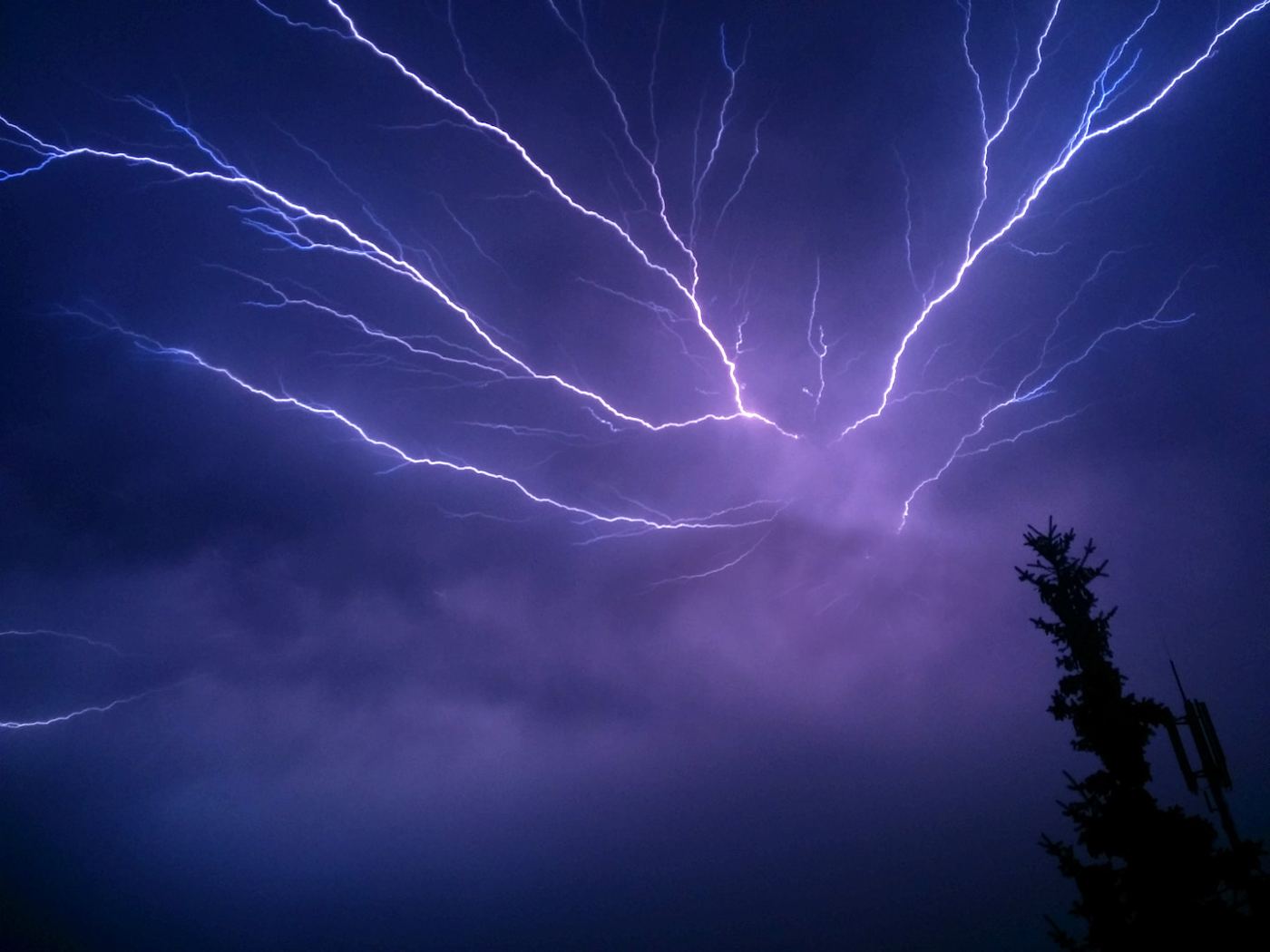
Lightning researchers are mapping how thunderstorms build the enormous electrical charges that eventually discharge as a flash, using networks of radio sensors that locate each burst inside the cloud in three dimensions. A storm separates charge through countless collisions between rising ice crystals and heavier falling pellets, which exchange tiny amounts of electricity each time they meet. Updrafts carry the lighter, positively charged crystals toward the cloud top while the heavier particles sink, creating layered regions of opposite charge. When the difference grows large enough, the air itself breaks down and a lightning channel forms along a jagged, branching path. Radio mapping arrays capture the faint pulses emitted as that channel extends, reconstructing flashes that remain entirely hidden inside the cloud. Most lightning never reaches the ground, and these intracloud flashes reveal storm development minutes before severe weather arrives at the surface. Forecasters therefore study flash patterns as an early warning signal for hail, damaging winds and flash flooding. Aircraft carrying electric field sensors add direct measurements from the edges of active storms. Together the data test computer models of how ice particles grow and collide, the microphysics at the heart of the whole process.
What the Evidence Shows
Field campaigns now coordinate ground arrays with weather radar and satellite lightning detectors, building a complete account of individual storms from birth to decay. Researchers have found that sudden jumps in flash rate often precede severe surface weather by ten to twenty minutes, a lead time emergency managers value highly. The same mapping clarifies how lightning ignites wildfires in dry regions, pinpointing which ground strikes land in receptive fuels. Climate scientists ask whether a warming atmosphere will produce more lightning overall, or mainly redistribute it, and long mapping records help answer with evidence rather than speculation. Laboratory experiments complement the fieldwork, charging ice particles under controlled conditions to measure exactly how much electricity each collision transfers. Surprises persist, including flashes that travel horizontally for hundreds of kilometres through layered cloud decks. Engineers use the improved understanding to design better protection for wind turbines, launch facilities and power networks. Public safety guidance also benefits, since knowing how storms charge helps explain why danger can arrive before rain begins. The research treats every flash as a report from inside the storm, and the reports are gradually assembling into a coherent physics of the sky most violent electricity. Reporting and analysis from sources such as Nature track the same developments, and specialists following thunderstorm charge formation mapping say the direction is now consistent across independent lines of evidence.
The Wider Context
The wider context is a research landscape in which replication and open data now decide reputations. Findings connected to thunderstorm charge formation mapping are being checked by independent groups with shared datasets, and the teams involved publish their methods in full so rivals can test every step. That discipline is slower than a headline cycle, but it is why results in this area increasingly survive first contact with scrutiny.
What Happens Next
What happens next in the story of thunderstorm charge formation mapping will be decided by follow-up work already under way: larger samples, longer observation and instruments that have not yet come online. The researchers involved are unusually united on one point, that the current results justify the next investment of time and money. Readers will not have to wait long for the first tests of that claim. You can follow related developments in our coverage of science.
None of this will be settled by a single announcement, study or product launch. The pattern to watch is accumulation: independent confirmations, honest reporting of failures and steady improvement in the underlying numbers. Readers who follow those signals, rather than the loudest claim of the week, will understand this subject better than most of the commentary surrounding it suggests is possible.
